


Question: After recently taking up running due to a midlife crisis of sorts, I am finding myself so fatigued after exercise I almost feel sick. I'm wondering if you can explain in layman’s terms why this might be happening.
Kirsten Taylor: The cellular energy process is complicated and relies heavily on the cells and the systems of the body to have the correct balance of nutrients and co-factors so the body can do what we are asking of it. There could be any number of reasons why you are feeling sick after exercising, but most likely it’s just that your body has been 'putt-putting' around like an old mini and has not been asked to perform at this level for a long time. It may simply be lacking the key nutrients needed to make it perform like a Ferrari! Happy human engine nutrients are B vitamins, Coenzyme Q10, our zinc/copper ratio in balance, adequate iron levels to deliver oxygen to our cells, and most importantly a large variety of different forms of magnesium.
Magnesium is a nutrient required in over 300 enzymatic processes including energy production (ATP). But what most people don’t know is that magnesium is also needed for the storage and utilisation of that energy (see Figure 1).
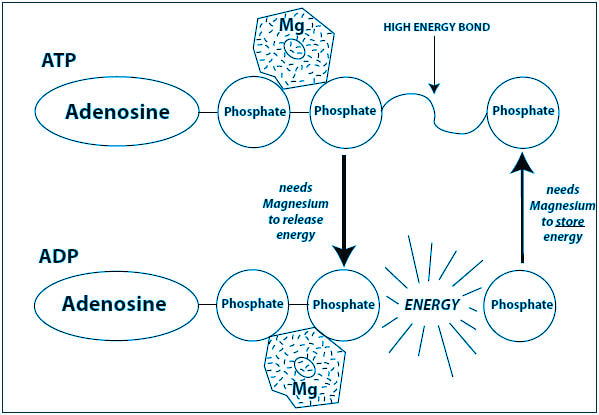
ATP is required for:
• Supporting muscle and nerve function making it possible for you to exercise and for your muscles to recover.
• Glucose utilisation and synthesis of fat, protein, nucleic acids and coenzymes, all of which fuel your muscles.
• Release of neurotransmitters which help our moods to feel good and normal neurological function which are necessary to exercise and recovery.
Uses of magnesium:
• Supports sleep, stress and response to poor-quality sleep.
• Supports slow-wave sleep (the most restorative sleep phases - theta and delta brain waves).
• Supports the stress response of the sympathetic nervous system - calming.
• Supports cortisol (stress hormone) from over-production.
• Supports running or any kind of sports/exercise endurance and recovery.
• Supports against fatigue.
• Supports muscles, such as when experiencing restless leg syndrome.
To feel and function at our best we must ensure we get the best possible sleep each and every night. Sleep is a highly dynamic process in which we repair, reset and rejuvenate every cell including our brains, which go through a 'washing process' whereby toxins and metabolites from the day before are washed away to help us think clearly. If we can’t think clearly we will find exercising and coordination tricky too. Magnesium plays a very important role in helping us achieve deep, slow-wave sleep which is when we repair. Unfortunately whilst many companies offer magnesium supplements, not all forms of magnesium are considered equal; not all can be utilised by the cells and not all feed the sleep, brain, muscles and energy cycles.
A comprehensive solution is to provide your body with a large selection, buffet or smorgasbord of as many different magnesium forms as possible to ensure every part of the body has access to the kind of magnesium it requires to function at its best.
To look and feel your best and get the results from your exercise efforts, please also invest in a varied diet where one 'eats the rainbow' with lots of foods with different colours of vegetables and fruits, healthy fats (not vegetable oils), and high-quality meat or non-meat protein alternatives that deliver a full amino acid profile. High-quality food is important to feed and nourish our muscles, our sleep and our overall health. These days we can also access high-quality supplements such as the new 'Magnesium 10' from SleepDrops. Magnesium 10 offers the most comprehensive 'multi-magnesium' supplement available with ten different forms of magnesium and no additives, colourings, flavours, preservatives or excipients – no nasties at all.
Available now exclusively through sleepdrops.co.nz
Kirsten Taylor
Naturopathic Sleep Specialist, Managing Director, Founder
SleepDrops® International Ltd
09 418 0479 ext 1
support@sleepdrops.co.nz
sleepdrops.co.nz


